

Imagine walking into a local bakery.
The owner proudly shows off a brand-new, £10,000 high-tech robotic arm. It waves at customers, sweeps the floor, and sorts napkin holders with incredible speed.
It looks impressive.
But at the end of the month, sales haven’t moved, long queues still stretch out the door, and the bakery is down ten grand.
Did that robotic arm actually help the business?
This is the exact trap thousands of business owners fall into with Artificial Intelligence. They jump on the hype, buy expensive AI tools, and assume efficiency will follow. But adopting AI doesn’t guarantee value.
If you want AI to boost your business, you have to ask one core question:
Is our AI investment bringing back more money than it takes to run?
Here is how to cut through the tech jargon and accurately measure your AI return on investment (ROI).
Step 1: Start with a Real Problem, Not the Tech
The single biggest mistake companies make is buying AI first and searching for a problem second.
Never ask, “Where can we fit AI into our company?”
Instead, look for where your operational pipe is leaking. Where is time being wasted? Where are costs quietly increasing? Where are repetitive tasks preventing your team from focusing on higher-value work?
Ask:
- Are customer support messages piling up unanswered?
- Are your employees spending half their week typing data into spreadsheets?
- Are costly human errors causing project delays?
When you pinpoint a specific bottleneck, picking the right solution—and measuring its success—becomes straightforward.
Step 2: Take a Snapshot Before You Start
You cannot prove a process improved if you don’t know where you started.
Before turning on any AI tool, take a quick baseline snapshot of your current numbers. You need something concrete to compare against once the system is running.
Look at three areas:
- Time: How many hours does this task take today?
- Cost: How much are you paying in labor or software for this task right now?
- Errors: How often do mistakes happen, and what do they cost to fix?
Without this “before” snapshot, claiming AI made your team “more productive” is just a guess.
The baseline gives you something far more useful than a promise.
It gives you a measurement.
Step 3: Count All the Costs (Not Just the Subscription)
It is easy to assume an AI tool only costs £30 a month because that’s what the website pricing page says.
But true ROI accounts for the Total Cost of Ownership.
The subscription is only one part of the investment. There may also be implementation, training, integration, maintenance, and human oversight involved in making the system useful.
Be sure to include:
- Direct fees: Monthly software subscriptions or pay-per-use API costs.
- Setup time: Paying developers to integrate the tool or paying staff during training hours.
- Double-checking: The hidden cost of team members reviewing and correcting AI outputs.
That last one is particularly important.
If a tool saves £500 a month in work but requires £600 a month in staff time to double-check its accuracy, it is costing you money.
The technology may look productive on paper.
The actual numbers tell a different story.
Step 4: A Simple Way to Do the Math
Let’s look at how this works in practice for a small business.
Suppose your customer support team spends 120 hours every month answering basic, repetitive questions. At £20 an hour, that routine support costs you £2,400 each month.
You install an AI support assistant.
Now, your team only spends 60 hours handling complex questions, while the AI takes care of the rest.
That changes the economics of the process:
- Labor costs saved: £1,200 / month
- AI system running cost: -£300 / month
- Net Monthly Profit from AI: £900 / month
In this setup, the tool pays for itself immediately while freeing up 60 hours for your staff to focus on closing sales and helping high-priority clients.
That is what a useful AI investment looks like.
Not impressive technology for its own sake, but a measurable improvement in the business.
Step 5: Ignore “Vanity” Numbers
Do not confuse activity with business results.
It sounds exciting to tell your team, “Our staff generated 10,000 AI responses this month!”
But that is a vanity metric.
Generating 10,000 responses doesn’t mean your business grew.
The more important question is what happened because those responses were generated.
Did customers receive answers faster?
Did employees have more time?
Did costs decrease?
Did more customers complete the process?
Focus on outcome-based questions instead:
- Did processing times drop?
- Did operating costs fall?
- Did revenue go up?
- Did error rates plummet?
The number of AI outputs is interesting.
The business result is what matters.
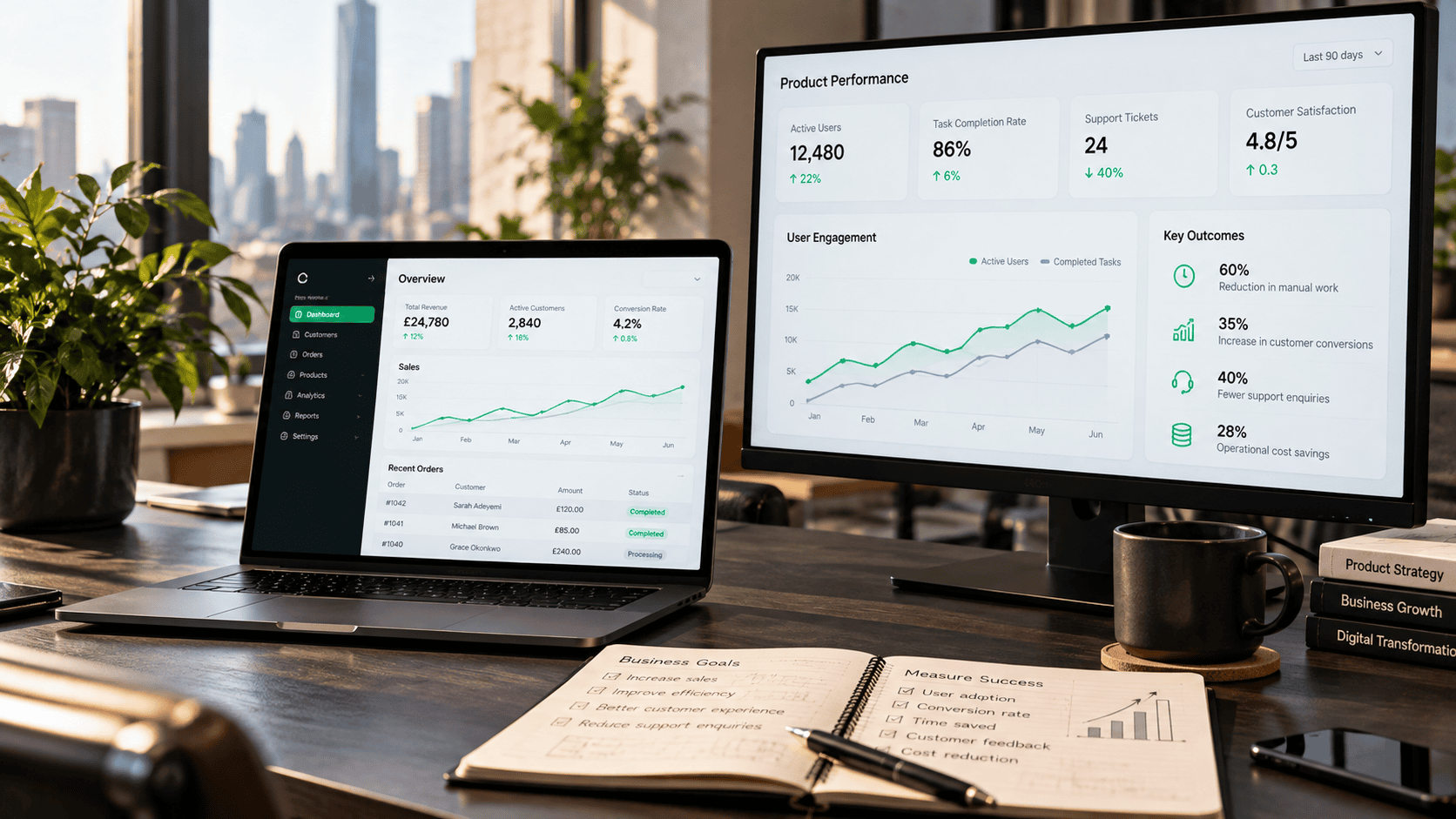
Quick Health Check: Is Your AI Working?
Once your AI system is running, keep tracking the same measurements you recorded before implementation.
A simple scorecard can make the difference between believing an AI investment is working and actually knowing that it is.
| Metric | Before AI | With AI | The Difference |
|---|---|---|---|
| Document Processing Time | 10 hours | 6 hours | 40% faster |
| Cost Per Task | £20 | £14 | 30% cheaper |
| Customer Response Time | 4 hours | 30 mins | 87.5% faster |
| Monthly Task Volume | 500 tasks | 700 tasks | 40% increase |
The purpose of the scorecard isn’t to make AI look successful.
It is to find out whether it actually is.
If your numbers stay flat after a few months, don’t be afraid to pull the plug.
AI should earn its keep just like any other business investment.
Real Value Beats Hype Every Time
AI is becoming increasingly accessible, but accessibility does not automatically create value.
The businesses that benefit most will not necessarily be the ones buying the most AI tools.
They will be the ones that understand where AI can make a measurable difference.
A good AI strategy starts with a business problem.
It establishes a baseline.
It accounts for the real cost.
It measures the outcome.
And it keeps asking whether the investment is producing enough value to justify itself.
At Seacom Soft, we believe technology should serve your business—not the other way around.
We help business owners identify their highest-impact opportunities, plug AI tools directly into existing workflows, and track every pound returned.
If you are ready to stop guessing and build an AI strategy that delivers real, measurable value to your business, let’s talk.


1 thought on “How Businesses Can Measure the ROI of AI”
A very keen Observation to be taken into consideration before Propagation. A very Good one Sir 👍