
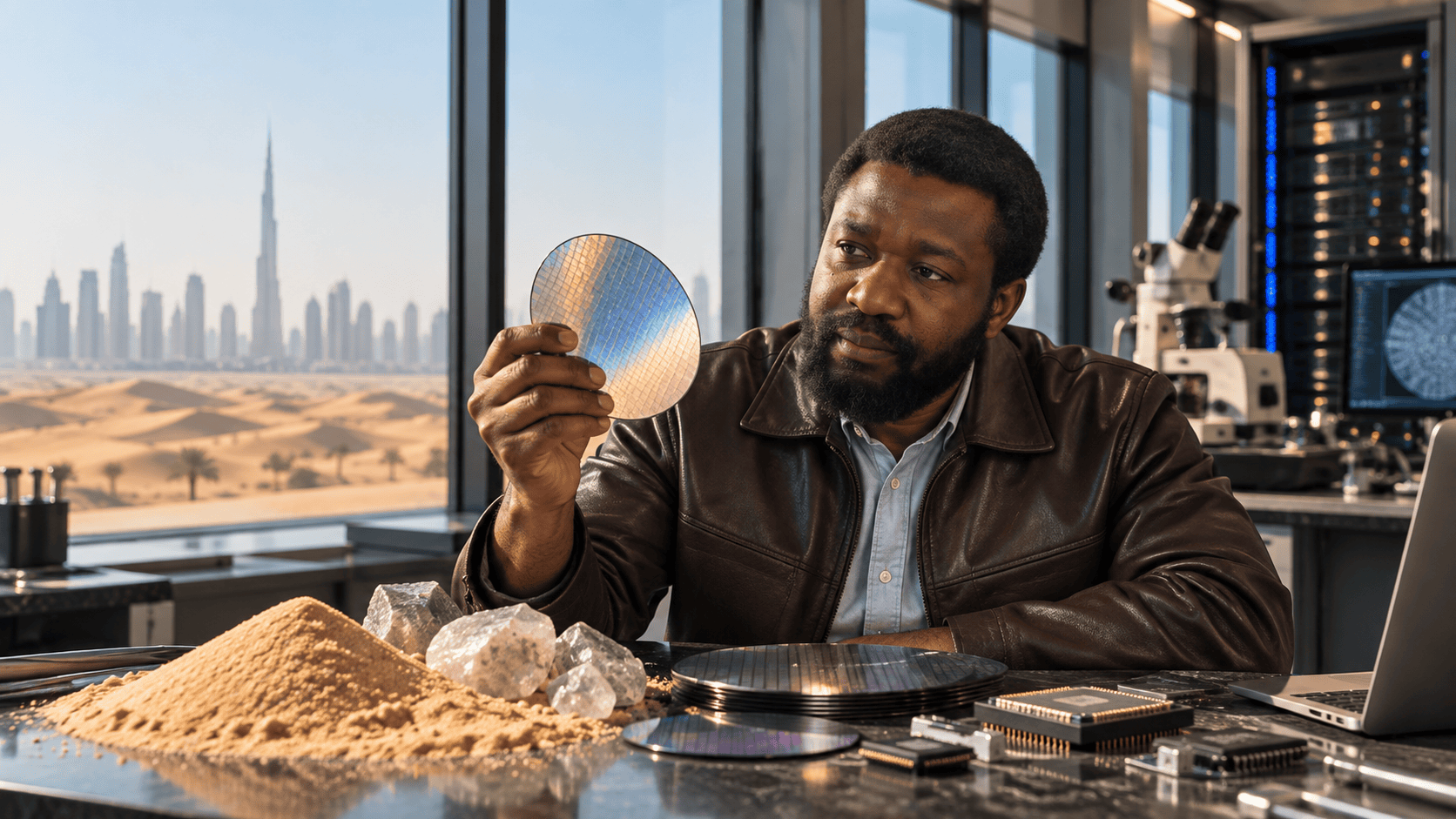
A grain of sand is an unimpressive thing.
It has no obvious ambition. It sits under a shoe, disappears into a tyre track, gathers in the corner of a room. Across much of the world, it is so abundant that we barely perceive it as a resource at all.
And yet, with enough purification, heat and precision, some sand becomes silicon. Silicon becomes wafers. Wafers become transistors. Transistors become processors. Somewhere down that chain sits the chip running the compiler, serving the API, rendering the interface or carrying the model answering a question like this one.
The distance between desert sand and an AI chip is enormous in engineering terms.
In material terms, it is strangely small.
This is what makes the recent movement of capital and technology between the United States and the United Arab Emirates interesting to me. In May 2025, the two countries signed an agreement allowing the UAE to import advanced American AI chips, alongside roughly $1.4 trillion in UAE investment pledges into the United States across AI, energy and infrastructure over the next decade.
The numbers are vast enough to make our mind lose its grip on them.
But the more interesting thing is not the scale of the deal. It is the material hiding underneath the abstraction.
A country whose modern wealth was built in large part on oil is placing an enormous claim on the machinery of computation.
Oil and Sand
Oil and sand belong to two very different economies of matter.
Oil is ancient sunlight, compressed through geological time and stored beneath the earth. We take it out, burn it and it is gone. Whatever else oil has been is fuel, wealth, geopolitical influence, industrial acceleration. Its defining property is that it is finite and consumable.
Sand behaves differently.
We have spent most of human history treating it as background. It is everywhere. It does not arrive with the drama of a barrel of crude. No tanker waits offshore to announce the next shipment of sand.
But technology has a habit of changing the value of things.
Take a grain of silicon dioxide. In its ordinary state, it is just another mineral. Purify the material to extraordinary levels, process it carefully, pattern it with structures too small to see and it becomes part of a machine capable of performing billions of operations.
The trick is not that sand is magical.
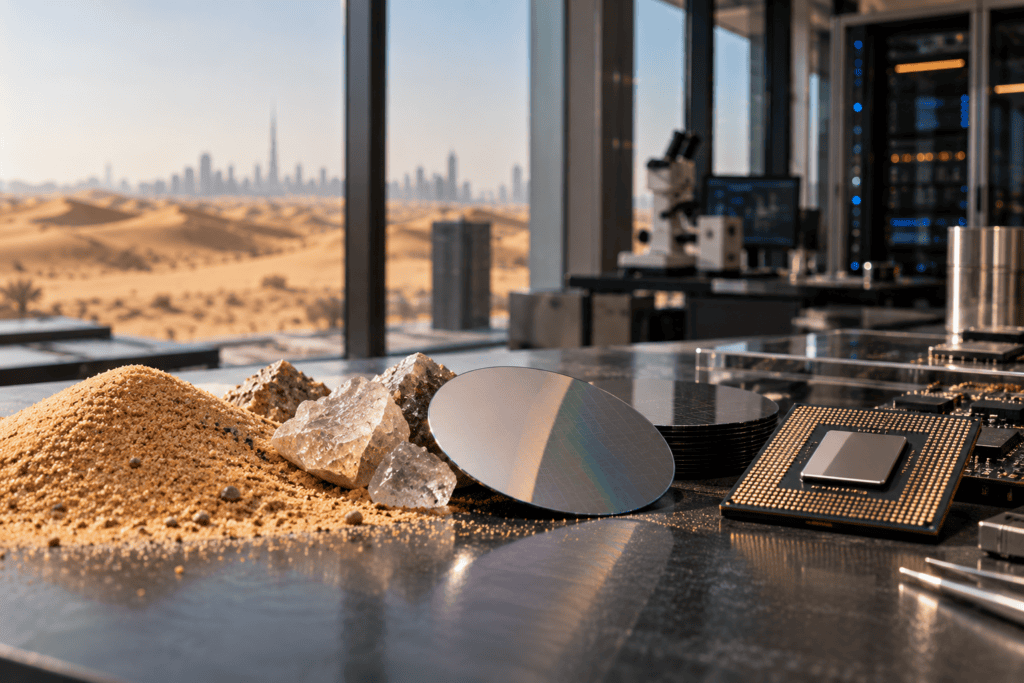
The trick is refinement.
That word matters because it offers a more useful way to think about software itself.
We often describe technology as if it creates something from nothing: an application appears, a model is trained, a platform launches, a new service reaches millions of people. But software has always been built by taking ordinary things and becoming obsessively precise about them.
A compiler takes human intent written in a programming language and transforms it into instructions a machine can execute. A server takes electricity, memory, storage and a network connection and turns them into a service someone can depend on. A line of code is almost offensively small compared with the system it can influence.
Engineering is full of these transformations.
The raw material is rarely the point.
The discipline applied to it is.
That is why the image of a desert trading oil for computation feels larger than a geopolitical transaction. It suggests a shift in what economies might increasingly prize: not merely what can be extracted from the ground, but what can be refined from what appears abundant.
The Problem With Abundance
There is a seductive simplicity to this idea, and it deserves some resistance.
Sand is not infinite in every practical sense. High-purity material suitable for advanced manufacturing is not the same thing as the sand beneath your feet. Semiconductor production requires extraordinary industrial capability, specialized equipment, energy, water, knowledge and coordination.
A desert full of sand does not, by itself, contain a semiconductor industry.
Nor does advanced computation become weightless simply because its most famous raw ingredient is abundant.
AI systems still depend on physical infrastructure. Chips sit in racks. Racks sit in buildings. Buildings consume energy. Networks cross physical distances. Every elegant abstraction in software eventually meets a wall, a cable, a power supply or a cooling system.
That tension is important.
Perhaps the future is not a clean transition from scarce resources to infinite ones.
Perhaps it is a transition from one kind of scarcity to another.
Oil gave economies energy they could spend.
Silicon gives engineers a medium they can organize.
The value increasingly lies in what can be done with the material rather than merely in possessing the material itself.
The Physical World Beneath the Abstraction
This is where software engineers enter the picture, quietly.
We are accustomed to thinking of ourselves as people who work with abstractions. Functions. Objects. Services. APIs. Models. Interfaces.
But those abstractions are only the upper floors of a building that begins much closer to the earth.
A user taps a button. The request travels through software, across networks, into machines assembled from minerals refined through industrial processes. Instructions are compiled. Electrons move. A processor performs its work. A response comes back.
The distance between the user’s intention and a grain of sand has become almost invisible.
Perhaps that invisibility is one of technology’s great achievements, and one of its great risks.
Software makes the physical world easy to forget. We can spend an afternoon arguing about a product roadmap without thinking about the silicon underneath the screen or the energy required to keep thousands of machines answering requests through the night.
The best engineers, I think, develop a different instinct.
They learn to see the layers.
They understand that an interface is attached to an API, that an API is attached to infrastructure, that infrastructure is attached to hardware, and that hardware is attached to a physical world that does not care how elegant the architecture diagram looks.
The desert has always known this.
From Extraction to Refinement
Beneath the romance of oil and the modernity of AI is a simpler fact: civilization keeps looking at matter and asking what else it can become.
The UAE’s investment and chip agreement with the United States is one real data point in that much larger story. Capital is moving toward computation. Nations are positioning themselves around AI. Infrastructure is becoming strategic. Materials that once looked ordinary are acquiring new significance because human ingenuity has found ways to refine them into something remarkably powerful.
There is something almost poetic in that.
A civilization once dug deep into the earth for ancient sunlight.
Now it is building machines from the substance it has been standing on all along.
The grain of sand has not changed.
What changed was our ability to imagine what it could become.
And perhaps that is the deeper lesson for anyone building technology.
The future rarely arrives as a completely new material. More often, it arrives when someone learns to see an ordinary thing differently, and then spends years refining it until the ordinary becomes extraordinary.
Somewhere between the desert and the server rack, between silicon and software, that process continues.
The alchemy was never in the sand.
It was in the refinement.



1 thought on “The Alchemy of Sand: From Oil to AI”
I don’t know engineering terms but I sure learnt a lot here.