
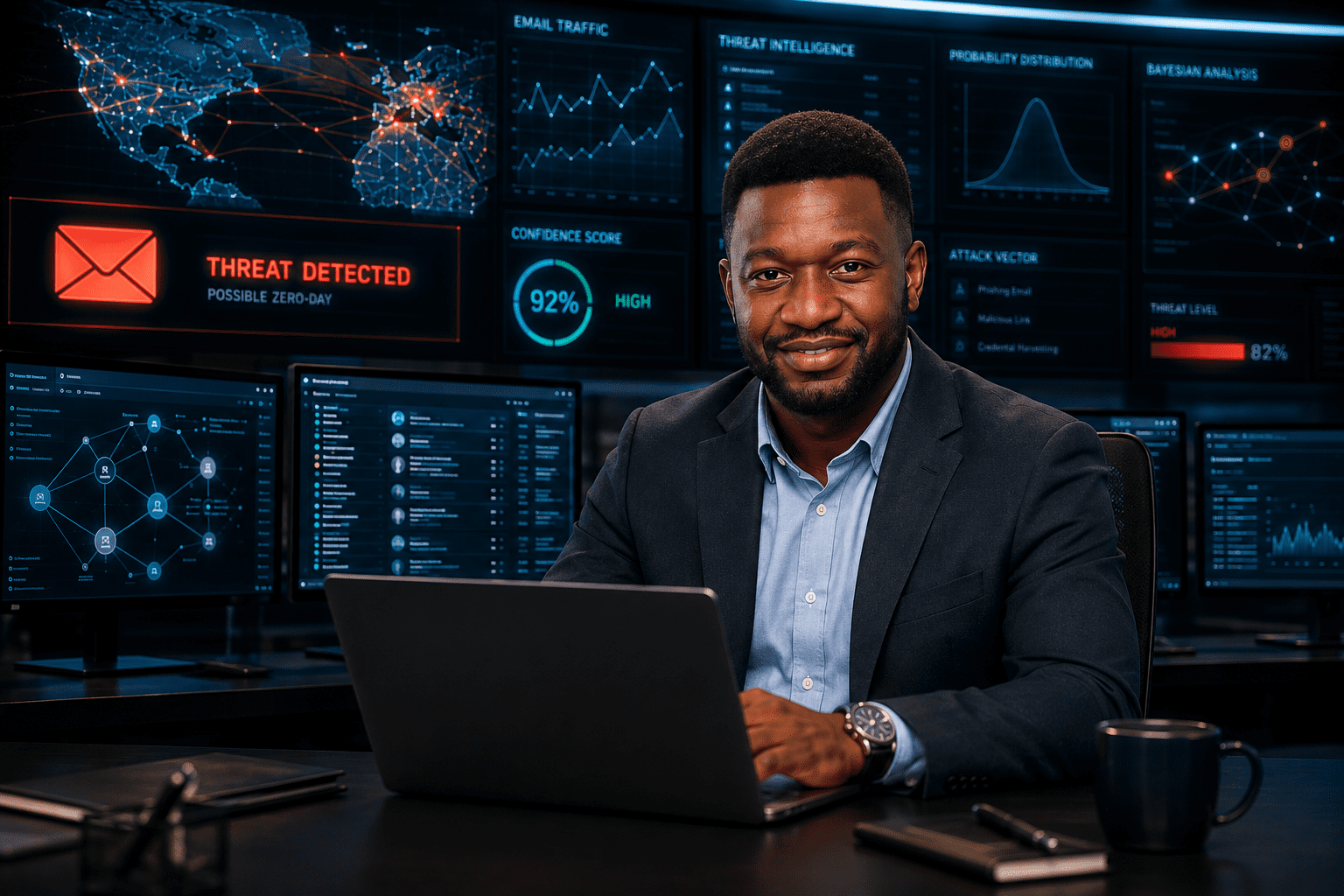
In the evolving theatre of cyberwarfare, email remains the primary invasion corridor. Over 90% of successful breaches begin with a single message, weaponized, disguised, and delivered with precision. These are not blunt force assaults; they are surgical infiltrations, often leveraging zero day tactics that evade signature based defenses.
PhishNet operates as a forward-operating cyber defense unit in this contested space. Its doctrine is not built on a single line of defense, but on a layered battlefield architecture where Bayesian filtering serves as one of the first reconnaissance and classification units in a broader intelligence network.
At the heart of this probabilistic reconnaissance lies Bayesian theorem.
This theorem governs how PhishNet evaluates uncertainty under fire. Each incoming email is treated as an unknown combatant. Rather than waiting for confirmed hostile signatures, the system calculates the probability that an email is malicious based on observed signals, including language patterns, structural anomalies, sender behaviour, and contextual indicators.
Bayesian filtering acts as the initial screening patrol. It analyses the statistical distribution of features within an email, comparing them against learned intelligence from both hostile (phishing/spam) and friendly (legitimate) communications. This allows the system to assign a probability score to each message, rather than making rigid, binary decisions.
But PhishNet does not fight with a single weapon.
Beyond Bayesian inference, the platform deploys a coordinated multi-layered defense strategy:
- AI-driven analysis that evaluates intent and behavioural patterns in real time
- Confidence scoring that quantifies threat probability for each email and URL
- Continuous scanning and alerting to detect evolving phishing campaigns before detonation
In military terms, Bayesian filtering is the reconnaissance unit—fast, adaptive, and constantly learning. It identifies suspicious movement early, even when the enemy has never been seen before. However, final engagement decisions are made by combining this probabilistic intelligence with deeper inspection layers, akin to drone surveillance, signals intelligence, and command-level threat assessment working in unison.
This layered approach is critical in zero day scenarios. Traditional filters that rely on known signatures or static rules are equivalent to defending yesterday’s battlefield. Bayesian systems, by contrast, learn continuously, adapting to new enemy tactics and reducing false positives by understanding what “normal” communication looks like within a given organisation.
The result is operational superiority in uncertainty.
PhishNet transforms ambiguity into actionable intelligence. Every email is assessed not just for what it is, but for what it could be. Threats are identified during their infiltration phase, before payload delivery, before user interaction, and before escalation.
This is not passive filtering.
This is probabilistic warfare, where Bayesian theorem serves as a tactical engine within a larger cyber defense arsenal, enabling PhishNet to detect, assess, and neutralise zero-day threats before they can establish a foothold.
In this battlespace, certainty comes too late.
Probability wins the war.