
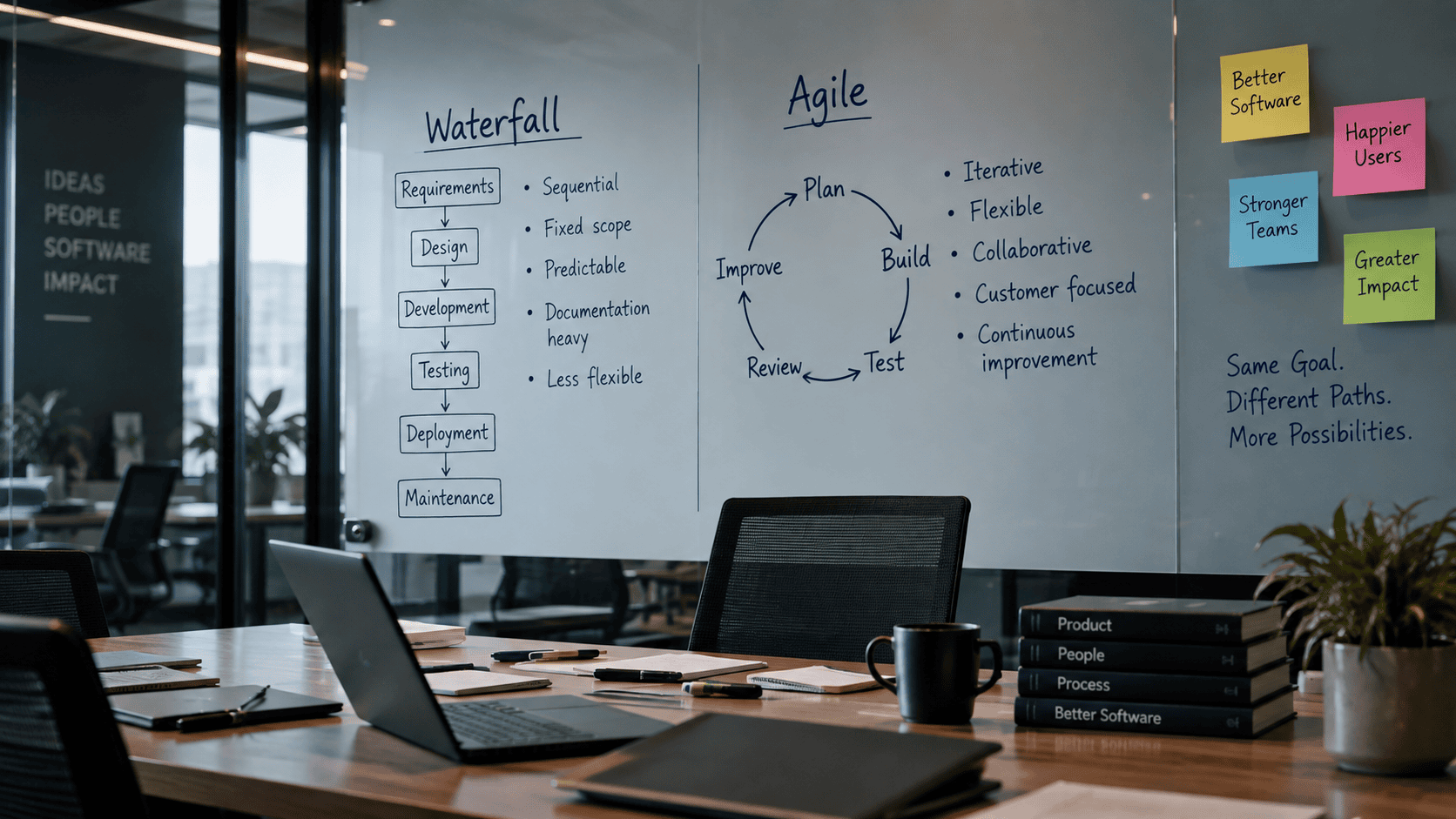
The software development industry has changed considerably over the years, and the way software projects are managed has evolved alongside it. For many years, traditional project management approaches such as Waterfall dominated software development. Today, however, Agile approaches such as Scrum, Kanban, and Lean have become increasingly popular, particularly in environments where customer expectations, technology, and business requirements can change rapidly.
The debate between traditional and Agile project management is not simply about deciding which methodology is better. Both approaches have strengths and weaknesses, and the most appropriate choice often depends on the nature of the project, the organisation, the development team, and the level of uncertainty involved.
Traditional Software Development Management
Before the widespread adoption of modern Agile approaches, Waterfall was one of the most commonly used methodologies for managing software development projects. Waterfall follows a structured and sequential process in which a project progresses through defined stages. These stages typically include requirements analysis, system design, implementation, testing, and deployment.
The fundamental principle of Waterfall is that one phase is generally completed before the next begins. Requirements are gathered and documented at the beginning of the project, followed by design and development, before testing and deployment take place.
One of the major advantages of Waterfall is its clear structure. Because the objectives, requirements, activities, and deliverables are usually established early, project managers can create detailed plans and allocate resources accordingly. This can provide greater predictability around project timelines and budgets, particularly when requirements are stable and unlikely to change.
The sequential nature of Waterfall can also make project progress easier to monitor. Each phase has defined outputs and milestones, allowing management to assess whether the project is progressing according to plan. For projects involving fixed requirements, formal contracts, extensive documentation, or strict regulatory requirements, this level of structure can be particularly useful.
However, the same structure that makes Waterfall predictable can also make it difficult to respond to change. Once a phase has been completed, returning to an earlier stage can be costly and time-consuming. This can become a significant problem in software development because customers may not always know exactly what they need at the beginning of a project.
Another major limitation is late feedback. In a traditional Waterfall project, customers and stakeholders may not see a working version of the software until relatively late in the development process. If the software does not meet the customer’s expectations, significant changes may be required after considerable time and resources have already been invested.
This can increase project risk. A project may be delivered according to the original specification but still fail to provide the expected business or customer value because the requirements, priorities, or market conditions have changed during development.
The Rise of Agile Software Development Management
Agile methodologies emerged as an alternative to many of the limitations associated with traditional sequential development. Rather than attempting to define and plan everything at the beginning, Agile focuses on flexibility, collaboration, iterative delivery, continuous feedback, and the ability to respond to change.
Scrum, Kanban, and Lean are among the approaches commonly associated with Agile software development, although each has a different focus.
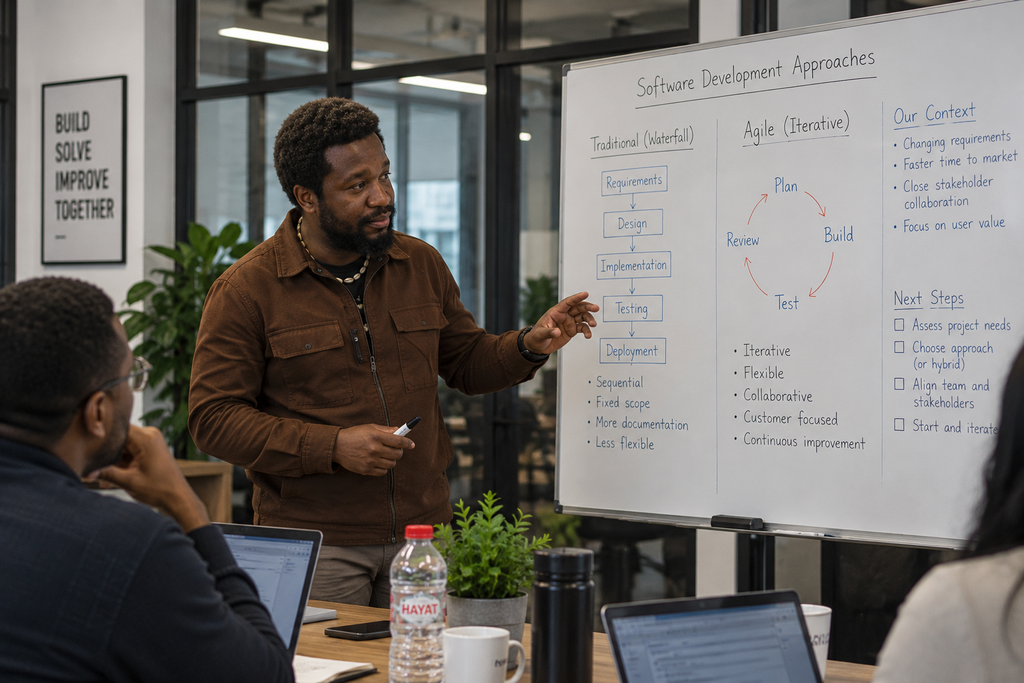
Scrum provides a structured framework in which teams work in short, defined periods known as Sprints. During each Sprint, the team works towards a specific goal and delivers a potentially usable increment of the product. Regular activities such as Sprint Planning, Daily Scrum, Sprint Review, and Sprint Retrospective provide opportunities for the team and stakeholders to inspect progress, receive feedback, and improve the way they work.
Kanban takes a different approach by focusing primarily on the flow of work. Work items are visualised on a Kanban board and progress through different stages, allowing teams to see what is being worked on, what is waiting, and what has been completed. Kanban also encourages teams to limit Work in Progress, helping them focus on completing work rather than starting too many tasks at the same time.
Lean software development focuses on maximising customer value while reducing waste. Waste can take many forms, including unnecessary processes, delays, rework, excessive handovers, and developing features that do not provide sufficient value to customers. Lean therefore encourages organisations to continuously examine their processes and identify opportunities to improve efficiency and delivery.
Why Agile Can Be Advantageous
One of the biggest advantages of Agile is flexibility. Unlike Waterfall, where requirements are generally established at the beginning, Agile allows teams to respond to changing requirements throughout the development process. This is particularly valuable in today’s technology environment, where customer expectations and business priorities can change quickly.
Agile also brings customers and stakeholders closer to the development process. Instead of waiting until the end of the project to evaluate the product, stakeholders can provide feedback throughout development. This creates opportunities to identify misunderstandings early and make adjustments before they become expensive problems.
Another advantage is the early identification of defects and other issues. Because software is developed and tested incrementally, problems can often be identified earlier in the development lifecycle. This can reduce the cost and effort associated with correcting defects later.
Agile can also support faster delivery of business value. Rather than waiting for an entire product to be completed, teams can deliver smaller pieces of functionality incrementally. This can allow organisations to release valuable features earlier and respond more quickly to market opportunities.
In addition, Agile encourages collaboration and team ownership. Teams are generally expected to work closely with Product Owners, customers, developers, testers, and other stakeholders. This collaborative environment can encourage innovation, accountability, continuous learning, and improvement.
The Challenges of Agile
Despite its advantages, Agile is not without its challenges. Successful Agile development requires active participation from stakeholders. Customers and Product Owners need to be available to provide feedback, clarify requirements, and make prioritisation decisions. Without this involvement, Agile teams may struggle to deliver the expected value.
Agile also requires a mature and disciplined team. Simply introducing Scrum meetings, a Kanban board, or a backlog does not make an organisation Agile. Teams need to understand the principles behind the methodology and have the ability to collaborate, communicate, prioritise, and take ownership of their work.
Another challenge is predictability. Because Agile allows requirements and priorities to change, it may be more difficult to establish a completely fixed budget, scope, and delivery date at the beginning of a project. This can be challenging for organisations that operate under strict fixed-price contracts or require extensive upfront planning.
Agile may also present challenges in heavily regulated environments where documentation, formal approvals, traceability, and predefined processes are critical. However, this does not necessarily mean that Agile cannot be used in such environments. Instead, organisations may need to adapt their Agile practices to meet regulatory and governance requirements.
Choosing the Right Approach
There is no universally “best” software development methodology. The right approach depends on the circumstances surrounding the project.
Waterfall can be highly effective when requirements are clearly understood, stable, and unlikely to change. It can also be appropriate where contractual obligations, regulatory requirements, or extensive upfront planning are important.
Scrum can be particularly useful for teams working on complex products where requirements are expected to evolve and regular feedback is required. Its defined roles, events, and Sprint structure can also provide useful guidance for teams that are developing their Agile practices.
Kanban can be more suitable for teams managing continuous work, such as software maintenance, support, service requests, or environments where priorities change frequently. Its emphasis on workflow and continuous delivery provides flexibility without requiring fixed development cycles.
Lean can help organisations that want to improve efficiency by identifying and eliminating activities that do not contribute sufficient value.
Ultimately, methodology should serve the project rather than the other way around. Organisations should avoid adopting a particular framework simply because it is popular. The chosen approach should reflect the project’s objectives, risks, stakeholders, team maturity, and business environment.
The Value of Hybrid Approaches
It is also important to recognise that software development methodologies do not always have to be treated as mutually exclusive. Many organisations combine practices from different approaches to create a process that works for their particular environment.
For example, Scrumban combines elements of Scrum and Kanban. A team may use Scrum’s structured approach to planning and review while also using Kanban principles such as visualising workflow and limiting Work in Progress.
Hybrid approaches can be useful because organisations often have different types of work and different levels of uncertainty within the same business. Rather than forcing every project or team to follow exactly the same process, organisations can select practices that address their specific challenges.
The success of any methodology ultimately depends less on the name of the framework and more on how effectively it is implemented. An organisation can follow Scrum ceremonies without genuinely embracing Agile principles, just as a Waterfall project can fail because of poor requirements, communication, or stakeholder management.
Conclusion
The evolution from traditional Waterfall development to Agile approaches such as Scrum, Kanban, and Lean represents a fundamental shift in the way software development can be managed. The emphasis has moved from rigid upfront planning towards adaptive delivery, from late feedback towards continuous collaboration, and from simply completing predefined tasks towards delivering measurable customer value and continuously improving the development process.
However, Agile does not make traditional project management obsolete. Waterfall remains a valuable approach for projects where requirements are stable, predictability is important, and extensive upfront planning is appropriate. Similarly, Agile approaches can provide significant benefits where requirements are uncertain, customer feedback is essential, and the ability to respond quickly to change is critical.
At Seacom Soft, we recognise that every software development project is different. Whether a project requires the predictability of Waterfall, the structured iteration of Scrum, the flexibility of Kanban, the efficiency principles of Lean, or a combination of different approaches, the most effective solution is one that fits the project’s specific context.
The goal of software development management should not be to force every project into a single methodology. Instead, it should be to create an environment where teams can collaborate effectively, respond to change, deliver meaningful value, and continuously improve.
The best methodology is not necessarily the one that is most popular; it is the one that enables the team and organisation to deliver the right product, at the right time, with the right level of quality and value.