
There is a strange moment happening in business right now.
Almost everyone is talking about artificial intelligence.
Companies are buying AI tools. Employees are using AI assistants. Developers are writing code with AI. Marketing teams are generating campaigns with it. Customer service teams are experimenting with automated responses. Executives are asking how AI can reduce costs, increase productivity, and create new opportunities.
And yet, something is being missed.
Having artificial intelligence is not the same thing as becoming an intelligent organisation.
The difference sounds subtle.
It isn’t.
A company can have the best AI tools available and still operate exactly as it did five years ago. The same meetings. The same approvals. The same spreadsheets. The same manual handoffs. The same disconnected systems. The same bottlenecks. The same person copying information from one application into another because the systems don’t communicate.
In that environment, AI becomes another tool sitting on top of an old way of working.
And that may be the biggest mistake businesses make with AI.
The Technology Has Changed. The Workflow Hasn’t.
For years, businesses have improved by purchasing better technology.
A faster computer. A better CRM. A new project management platform. Cloud infrastructure. Analytics software.
Now, artificial intelligence has joined the list.
But there is a problem with simply adding technology to an existing process.
If the process itself is inefficient, technology can sometimes make an inefficient process faster without making it better.
Imagine a company where a customer submits an enquiry. Someone reads the email. Someone copies the details into a spreadsheet. Another person checks availability. Another person prepares a quotation. A manager approves it. Someone sends it back to the customer.
Now introduce AI.
Perhaps AI writes the email. Perhaps AI summarises the enquiry. Perhaps AI prepares the quotation.
But if five people still have to move information between six different systems, the fundamental problem hasn’t disappeared.
The business has automated pieces of the process.
It hasn’t redesigned the process.
That distinction matters enormously.
Microsoft’s 2026 Work Trend Index describes a similar shift: the organisations gaining the most from AI are not simply giving people more tools; they are redesigning workflows, documenting how humans and agents work together, and changing how work itself is organised.
The future isn’t simply about having smarter software.
It is about building smarter systems around people.
AI Should Remove the Friction Between Decisions
Think about how much time a business loses without ever recording it as a loss.
An employee searches through an old email. A manager waits for a report. A customer repeats information they’ve already provided. A developer looks through three systems to understand what happened. A finance employee downloads a spreadsheet and manually combines it with another spreadsheet. A project manager asks five people for the same update.
None of these activities looks catastrophic.
Together, they become an invisible tax on the organisation.
And this is where AI becomes genuinely interesting.
The opportunity isn’t merely to ask a chatbot to write something faster.
The bigger opportunity is to connect intelligence to the actual flow of work.
A customer enquiry could be understood automatically, routed to the right team, checked against existing information, and prepared for human review.
A software issue could be detected, classified, linked to previous incidents, and presented to an engineer with the relevant context already assembled.
A management report could be generated from live business systems rather than waiting for someone to spend half a day collecting numbers.
A developer could receive not just an AI-generated suggestion, but the relevant documentation, previous implementation decisions, test results, and system context needed to make a better decision.
That is a different kind of automation.
It doesn’t simply automate a task.
It reduces the distance between information and action.
And that is where the real advantage begins.
The Most Valuable AI May Be the AI Nobody Sees
We tend to imagine AI through interfaces.
A chat window. A prompt. A generated image. A coding assistant. A voice conversation.
But some of the most valuable applications of AI may have no obvious AI interface at all.
The customer may never know AI was involved. The employee may never type a prompt. The manager may simply notice that a report arrived earlier. The developer may simply notice that finding the right piece of information took seconds instead of twenty minutes. The customer may simply experience a faster response.
That is when technology becomes truly useful.
It disappears into the experience.
The best automation doesn’t announce itself.
It simply removes the unnecessary steps.
The New Competitive Advantage Is Connected Intelligence
For decades, companies competed through access to information.
Then they competed through access to technology.
Increasingly, the advantage will come from what an organisation can do with the information and technology it already has.
A company might possess excellent customer data, a powerful CRM, cloud infrastructure, analytics, internal documentation, software systems and AI models.
But if those systems operate like separate islands, the organisation still has a problem.
Information exists.
Intelligence exists.
The connection between them doesn’t.
That connection is where modern software engineering becomes increasingly important.
AI doesn’t eliminate the need for good architecture.
It makes good architecture more valuable.
It doesn’t eliminate APIs, databases, security, cloud infrastructure, documentation, monitoring or well-designed applications.
It makes those foundations more important because intelligent systems need reliable information and reliable systems to act on.
You cannot build a dependable AI-driven organisation on top of disconnected, poorly maintained foundations.
The intelligence may be artificial.
The consequences are very real.
The Companies That Win Won’t Necessarily Have the Most AI
This is where the conversation becomes more interesting.
The question shouldn’t be:
“How much AI are we using?”
A better question is:
“Where is work unnecessarily difficult?”
That question changes everything.
Instead of starting with a technology and searching for somewhere to use it, businesses can start with friction.
Where do employees repeatedly perform the same task? Where does information get copied manually? Where do customers wait unnecessarily? Where do approvals become bottlenecks? Where do teams repeatedly ask the same questions? Where does important knowledge disappear into email, chat messages, or individual employees’ memories? Where are people spending their time doing work that a system could safely handle?
Those questions reveal opportunities that a technology-first approach can miss.
And sometimes the answer won’t even be AI.
It might be a better API. A redesigned workflow. A properly integrated database. A faster website. A better internal application. A clearer documentation system. A more reliable cloud architecture.
Technology should serve the problem.
Not the other way around.
The Human Part Becomes More Important, Not Less
There is another misconception worth challenging.
As AI becomes better at execution, some people assume human involvement becomes less important.
In many situations, the opposite is true.
When machines can handle more execution, humans have more room to focus on judgement, context, strategy, creativity, relationships, ethics, leadership, and the difficult questions.
Microsoft’s 2026 research found that 66% of surveyed AI users said AI allowed them to spend more time on higher-value work, while 58% said they were producing work they could not have produced a year earlier. Among its most advanced users, those numbers were higher.
The implication is important.
The goal shouldn’t be to remove humans from every process.
The goal should be to stop wasting human capability on work that doesn’t require it.
A good system knows when to automate.
A good system also knows when to stop and ask a person.
That boundary is part of good engineering.
We Are Moving From Software That Executes to Software That Participates
For a long time, software waited for instructions.
You clicked a button. The software responded.
You entered information. The system processed it.
You opened a report. The application displayed it.
AI and agentic systems are beginning to change that relationship.
Software can increasingly interpret information, reason across multiple steps, retrieve context, make recommendations, and in some situations execute actions.
That doesn’t mean every process should become autonomous.
It means the relationship between people and software is changing.
The interface is no longer necessarily a screen full of buttons.
Sometimes the interface is a conversation.
Sometimes it is an automated workflow.
Sometimes it is a system that quietly notices something before anyone asks.
The important question is no longer simply:
“What can the software do?”
It is:
“What should happen next?”
The Architecture of the Next Generation of Businesses
This is why the next stage of digital transformation will be less about collecting applications and more about designing systems.
The strongest organisations will increasingly think about their technology as one connected environment rather than a collection of unrelated tools.
Customer information should be able to move securely between relevant systems. Business processes should be visible. Data should be trustworthy. Documentation should remain current. Software should be observable. Infrastructure should be resilient. AI should have appropriate access to information. Humans should remain accountable for consequential decisions.
And the entire system should be designed around how work actually happens.
That sounds less exciting than announcing another AI product.
It is probably much more important.
Because technology creates possibilities.
Systems turn those possibilities into results.
The AI Race Is Becoming a Systems Race
There will always be another model. Another AI assistant. Another agent. Another platform promising to transform your business overnight.
The technology will continue to change at extraordinary speed.
But the underlying challenge will remain remarkably familiar:
Can your organisation turn technology into useful work?
That is an engineering question.
It is a product question.
It is a leadership question.
And increasingly, it is a competitive question.
The companies that understand this will stop asking which AI tool they should buy next and start asking which parts of their organisation should work differently.
They will redesign processes before automating them.
They will connect systems instead of adding more isolated ones.
They will give AI access to reliable information rather than expecting intelligence to compensate for bad data.
They will build safeguards around automation instead of assuming automation is automatically safe.
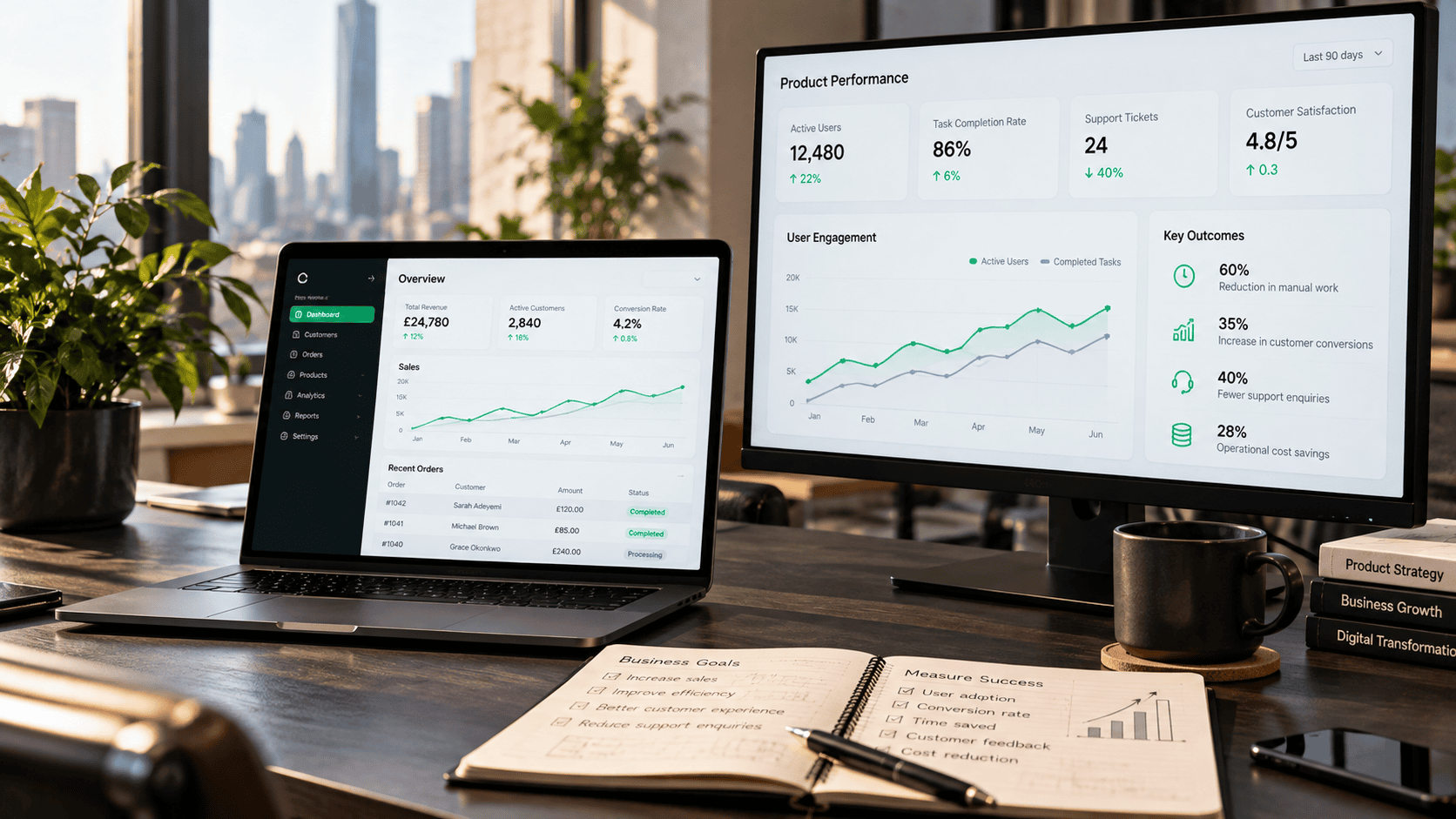
And they will measure success by outcomes rather than the number of AI tools employees have access to.
The Real Transformation Is Happening Somewhere Else
AI may be the most visible technology revolution of our generation.
But the most important transformation may happen somewhere much quieter.
Inside the workflow.
Inside the architecture.
Inside the systems connecting people, information and decisions.
That is where businesses either become dramatically more capable or simply become businesses with more software.
The distinction will matter.
Because in the years ahead, almost every company will have access to powerful AI.
Not every company will know how to build it into the way they work.
And when intelligence becomes widely available, intelligence itself stops being the rare advantage.
The advantage becomes knowing what to do with it.
That is the real opportunity.
Not to make people work faster.
Not to replace every human task.
Not to add AI to everything.
But to build organisations where technology quietly removes friction, people spend more time on meaningful decisions, and every system works as part of something larger.
The future of technology will not belong to the companies with the most impressive tools.
It will belong to the companies that build the most intelligent way of working around them.
And that transformation has already begun.