
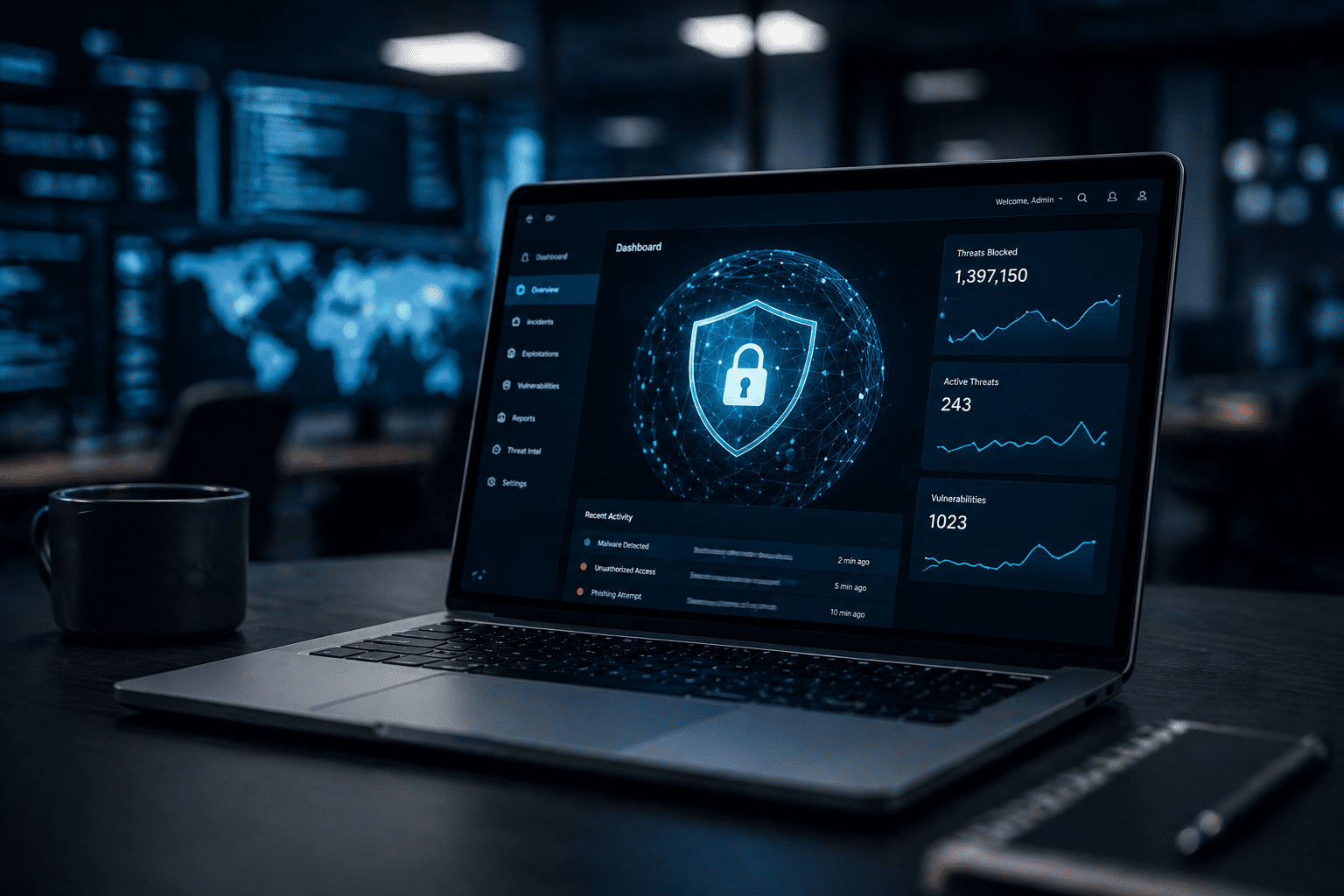
Most about cybersecurity focus on loss.
Lost money. Lost data. Lost trust. But there’s another cost that rarely gets discussed, the cost of defending against threats. Because behind every secure system is something that never truly rests. It is constantly scanning, filtering, flagging, and rechecking. Every second, it processes signals, evaluates patterns, and tries to separate what matters from what doesn’t.
And all of that activity consumes something very real: time, infrastructure, and energy.
The Invisible Weight of Always-On Security
Modern cybersecurity systems are designed to be relentless. They monitor everything, analyze everything, and often store far more data than they actually need, just in case something becomes relevant later. On the surface, that sounds like strength. But in practice, it often creates a different kind of problem.
- Systems end up doing far more work than necessary.
- Security teams become overwhelmed by alerts that rarely lead to real threats.
- Infrastructure runs continuously at high capacity, even when the risk level doesn’t justify it.
It’s similar to leaving every light in a building on, all day and all night, just to make sure no one ever trips in the dark. It works — but the cost adds up quickly.
Phishing: A Simple Entry Point with Complex Consequences
Phishing remains one of the most common entry points for cyberattacks. On the surface, it appears simple, just an email, a link, or a message. But behind that simplicity is a surprisingly heavy process. Every suspicious message triggers multiple layers of analysis. Systems examine content, verify links, validate senders, and assess behavior. Each step requires processing power, time, and coordination across systems.
Now multiply that across thousands or even millions of messages every day. What emerges is not just a security challenge, but a resource challenge. A significant portion of system capacity is spent evaluating threats that never materialize. When systems aren’t optimized, most of that effort is wasted.
A Different Approach to Security
PhishNet was built on a different principle.
Not “catch everything at all costs,”
but “catch what matters, and do it well.”
That distinction may seem small, but it fundamentally changes how a system behaves. Instead of treating every input as equally important, PhishNet focuses on precision. It prioritizes intelligently, reducing unnecessary work across the system while improving the quality of detection.
This is not about doing less for the sake of efficiency. It’s about doing the right work, at the right time, with the right level of focus.
What Smarter Security Actually Looks Like
In many organizations, the biggest challenge is not the absence of security, it’s the noise. Security teams spend a large portion of their time investigating alerts that turn out to be harmless. This creates fatigue, slows response times, and makes it harder to focus on real threats. By improving detection accuracy, PhishNet reduces that noise. When something is flagged, it carries weight. It demands attention for the right reasons.
This shift changes how teams operate. Instead of reacting constantly, they respond deliberately.
At the system level, the impact is just as significant. Rather than processing every signal with the same intensity, resources are allocated more intelligently. Redundant scans are avoided. Unnecessary processing is reduced.
The system becomes lighter, not weaker, but more focused.
Scaling Without the Burden
As organizations grow, their security systems typically grow with them. More users bring more data, more interactions, and more potential threats. In many cases, this leads to heavier systems that consume more infrastructure and require more maintenance.
PhishNet approaches scaling differently. Instead of expanding blindly, it adapts based on actual threat patterns. Resources are increased when needed, not by default. Performance is maintained without introducing unnecessary complexity.
This allows growth without the usual trade-offs. The system remains efficient even as it becomes more capable.
The Sustainability Conversation Most Teams Miss
There is another dimension to cybersecurity that is often overlooked: environmental impact. Every process running in a data center consumes energy. Every unnecessary computation adds to that demand. Even storing data that will never be used has a cost. When systems are inefficient, they quietly increase their environmental footprint.
PhishNet doesn’t treat sustainability as a separate goal. It emerges naturally from better design decisions.
By reducing unnecessary processing and focusing on precision, the system lowers resource consumption as a direct outcome of efficiency.
Not as a marketing claim, but as a consequence of thoughtful engineering.
Why This Shift Matters Now
Cyber threats are evolving, but so is the digital landscape. Businesses are becoming more connected, more data-driven, and more dependent on real-time systems.
If cybersecurity continues to scale inefficiently, it creates new challenges.
- Systems become slower.
- Operational costs rise.
- Infrastructure demands increase.
Over time, the systems designed to protect businesses begin to weigh them down.
That’s not sustainable, technically, financially, or environmentally.
Rethinking What Strong Security Means
For a long time, strength in cybersecurity was associated with doing more.
More checks. More layers. More tools.
But the future is moving in a different direction. Strength is becoming more about precision than volume. More about efficiency than intensity. More about intentional design than reactive complexity.
PhishNet reflects that shift.
Building Systems That Think
The goal is no longer just to stop threats. It’s to build systems that understand patterns, use resources intelligently, and provide protection without unnecessary strain. Because the best systems don’t just work.
They think.
The Bottom Line
You don’t need heavier systems to be more secure. You need smarter ones. PhishNet demonstrates that cybersecurity can be effective, efficient, and sustainable at the same time. And increasingly, that’s not just an advantage.


5 thoughts on “PhishNet: Building Smarter, Safer, and More Sustainable Cybersecurity Systems”
Cybersecurity is often measured by what it prevents, but rarely by what it consumes. This article offers a refreshing perspective that the future of security isn’t about adding more weight to our systems but it’s about making them smarter. In a world full of digital noise, precision may be the most powerful defense of all.
nice read
This was insightful
This was insightful
interesting read! I especially liked the comparison to leaving the lights on always. it drove the point home