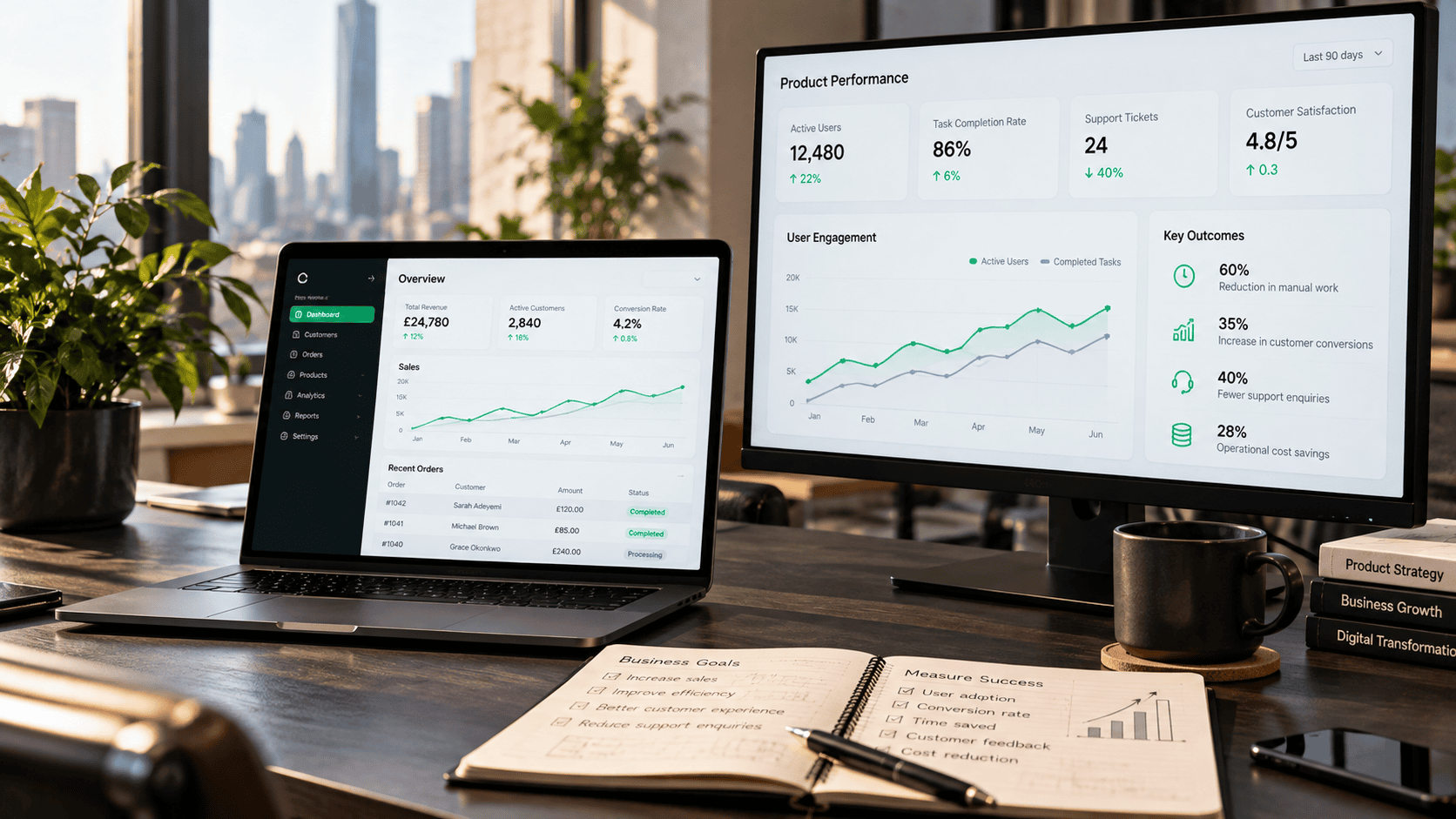

Artificial intelligence is no longer a technology reserved for well-funded enterprises with dedicated research departments. In 2026, AI has become one of the most accessible and cost-effective tools available to small and medium-sized businesses and the organisations that understand this early will hold a measurable competitive advantage over those that don’t.
This post covers areas where AI delivers genuine, proven value for smaller businesses, what to realistically expect, and how to get started without overextending your resources.
The Shift That Has Already Happened
For most of the last decade, deploying AI required significant investment:
- Data engineers
- Machine learning infrastructure
- Proprietary datasets
- Months of development time
That barrier no longer exists in the same form.
The emergence of large language models (LLMs), low-code AI platforms, and AI-native SaaS tools has fundamentally changed the economics. A business with five employees can now access the same underlying AI capabilities as a Fortune 500 company, the difference lies in how strategically they apply it.
The question is no longer can small businesses use AI. It is where should they focus first.
High-Impact Applications for Small Businesses
1. Customer Communication and Support Automation
One of the most immediate and measurable applications of AI for small businesses is in customer-facing communication. AI-powered chatbots and virtual assistants can handle routine enquiries like order status, pricing, availability, booking requests, with accuracy and consistency, 24 hours a day.
Businesses report reductions in first-response time, lower support costs, and improved customer satisfaction scores when AI handles tier-one queries. Human agents are freed to focus on complex, high-value interactions that genuinely require judgement and empathy.
2. Content and Communications Workflows
AI is proving highly effective at accelerating content production, not by replacing human expertise, but by eliminating the blank-page problem and compressing draft-to-publish timelines.
Practical applications include:
- Drafting proposals and client communications
- Generating product descriptions at scale
- Producing internal documentation
- Creating structured outlines for marketing content
The critical point is that AI-generated content should always be reviewed and refined by a human who understands the brand voice and audience. Used correctly, it functions as a force multiplier for a lean team.
3. Business Intelligence and Data Interpretation
Many small businesses are already generating meaningful operational data through tools such as accounting platforms, CRM systems, website analytics, and inventory management software that they use daily. The challenge, typically, is not a lack of data but a lack of capacity to analyse it consistently.
AI-powered analytics tools can surface patterns, flag anomalies, and generate plain-language summaries of performance trends without requiring any technical expertise to operate. Identifying which customers are at risk of churning, which products are underperforming, or where operational costs are drifting, these are insights that were previously accessible only to businesses with dedicated analysts.
4. Process Automation
Beyond customer-facing applications, AI is enabling small businesses to automate internal workflows that have traditionally consumed disproportionate staff time.
- Invoice processing
- Appointment scheduling
- Data entry
- Compliance documentation
- Employee onboarding
Each represents an opportunity to reduce manual effort and the associated risk of human error.
Platforms such as Zapier, Make, and Microsoft Power Automate now incorporate AI features that allow non-technical users to build sophisticated automation workflows within hours, not weeks.
Sector-Specific Considerations
The principles above apply broadly, but implementation varies by industry.
Healthcare
Healthcare providers must navigate strict data governance requirements such as GDPR and, where applicable, NHS information governance standards. Within those parameters, AI can meaningfully reduce administrative burden:
- Automating appointment reminders
- Triaging patient queries
- Flagging gaps in follow-up care
- Supporting clinical documentation
The key is ensuring that any AI system handling patient data is built on a compliant, auditable infrastructure.
Automotive
Automotive businesses such as dealerships, fleet operators, and service providers are well positioned to benefit from AI in inventory management, customer matching, and predictive maintenance scheduling. AI can analyse a customer’s stated preferences and purchase history to surface relevant stock, or monitor vehicle service data to proactively schedule maintenance before issues arise.
Enterprise and Professional Services
Enterprise and professional services firms can leverage AI to streamline internal operations. Intelligent document management, automated reporting, and AI-assisted project tracking all reduce the cognitive load on senior staff and create more consistent outcomes at scale.
What AI Does Not Replace
It is important to be precise about AI’s limitations, because misaligned expectations are one of the primary reasons implementations fail.
AI is a tool for pattern recognition, content generation, and process automation.
- It does not exercise judgement in the way an experienced professional does
- It does not understand the nuances of your client relationships, your market context, or your organisational strategy
- Outputs, particularly in customer-facing or regulated contexts, require human oversight
A well-designed process, automated with AI, becomes faster and more consistent. A poorly designed process, automated with AI, produces poor results at higher volume.
Operational foundations must be sound before automation is applied.
A Framework for Getting Started
For businesses at the beginning of their AI journey, the following approach reduces risk and accelerates time to value:
- Identify the highest-friction tasks in your current operation. Those tasks that consume the most time relative to the value they produce
- Research purpose-built tools for those specific tasks before defaulting to general AI platforms
- Run a structured pilot over four to six weeks with defined success metrics such as time saved, error rate, customer satisfaction, or cost reduction
- Evaluate and expand based on pilot results, rather than attempting organisation-wide transformation in a single initiative
This approach is deliberate, low-risk, and builds internal confidence in AI-driven processes before scaling investment.
Working With the Right Technology Partner
Implementing AI effectively, particularly in regulated industries or where custom integration is required demands technical expertise and strategic understanding in equal measure.
At Seacom Soft, we work alongside businesses in healthcare, automotive, enterprise, and beyond to design and build AI solutions that are fit for purpose, compliant, and built to scale. Our approach is grounded in understanding how your business actually operates before recommending or building anything.
Ready to Explore What AI Can Do for Your Business
If you are looking to apply AI in a way that delivers real value, not just experimentation:
Visit https://seacomsoft.com/
Let’s build something that works.