
Introduction
As modern software development continues to evolve, businesses need deployment platforms that are reliable, scalable, cost-effective, and easy to manage. While cloud-native services such as AWS Amplify have become popular for hosting and deploying applications, many organizations are increasingly exploring open-source alternatives that provide greater flexibility and lower operational costs.
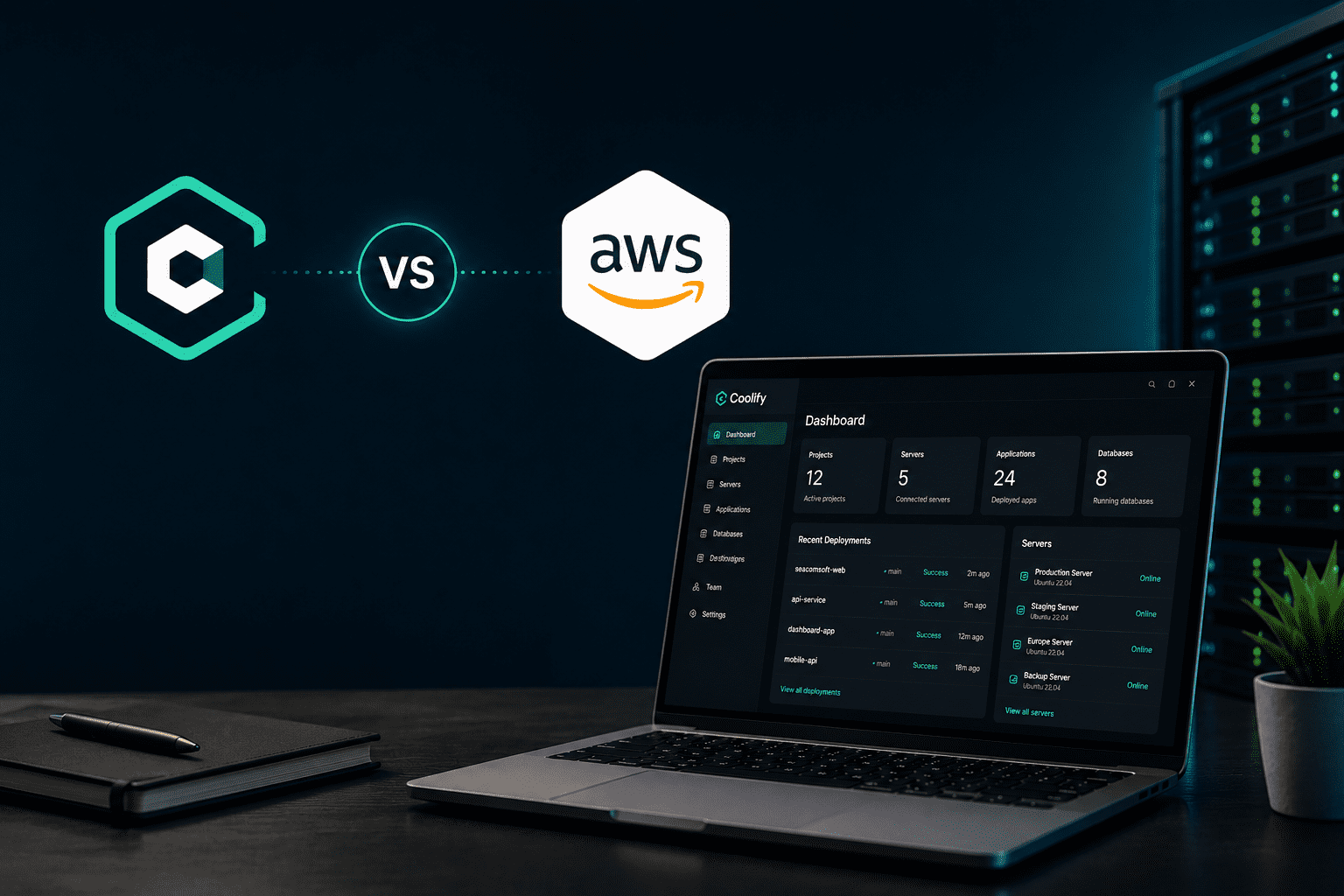
One platform that has gained significant attention in recent years is Coolify. Designed as a self-hosted Platform-as-a-Service (PaaS), Coolify enables organizations to deploy and manage applications, databases, services, and servers from a centralized interface without being locked into a single cloud provider.
At Seacom Soft, we leverage Coolify to streamline deployments, manage infrastructure across multiple servers, and maintain full control over our hosting environment while reducing cloud platform costs.
What is Coolify?
Coolify is an open-source deployment and infrastructure management platform that allows developers and organizations to deploy applications directly from Git repositories to their own servers.
Think of Coolify as a self-hosted alternative to platforms such as AWS Amplify, Heroku, Vercel, or Railway. Instead of relying entirely on a managed cloud service, Coolify allows businesses to use their own servers while providing a modern deployment experience.
With Coolify, teams can:
- Deploy applications directly from GitHub, GitLab, and Bitbucket repositories
- Manage Docker-based applications
- Deploy databases and services
- Configure domains and SSL certificates automatically
- Monitor application deployments
- Scale across multiple servers
- Maintain full ownership of infrastructure
This approach combines the convenience of modern deployment platforms with the flexibility and cost advantages of self-hosted infrastructure.
Coolify vs AWS Amplify
AWS Amplify is a fully managed service provided by Amazon Web Services that simplifies frontend and backend application deployment. While it offers seamless integration with the AWS ecosystem, it can become restrictive or expensive as infrastructure requirements grow.
Similarities
Both Coolify and AWS Amplify provide:
- Continuous Integration and Continuous Deployment (CI/CD)
- Git-based deployments
- Automatic application builds
- Environment variable management
- SSL certificate provisioning
- Custom domain support
- Deployment monitoring
- Team collaboration capabilities
For development teams, the overall deployment experience feels very similar.
Key Differences
| Feature | Coolify | AWS Amplify |
|---|---|---|
| Open Source | Yes | No |
| Self-Hosted | Yes | No |
| Vendor Lock-In | Minimal | High |
| Infrastructure Ownership | Full Control | AWS Managed |
| Multi-Cloud Support | Yes | Limited |
| Custom Server Support | Yes | No |
| Pricing Model | Server-Based | Usage-Based |
| Database Hosting | Supported | Requires AWS Services |
The most significant difference is ownership and flexibility. AWS Amplify ties applications closely to AWS services, whereas Coolify allows deployment on virtually any Linux server, whether hosted on AWS, DigitalOcean, Hetzner, Linode, Azure, or on-premises infrastructure.
Why Organizations Are Choosing Coolify
Reduced Hosting Costs
Many businesses discover that AWS costs increase rapidly as applications scale. With Coolify, organizations can host multiple applications on a single server while maintaining centralized management.
Instead of paying for multiple managed services, teams can maximize server utilization and reduce operational expenses.
No Vendor Lock-In
Organizations retain complete control over their infrastructure. If a hosting provider changes pricing or service terms, applications can easily be migrated to another provider without changing deployment workflows.
Full Infrastructure Visibility
Unlike managed cloud platforms that abstract away infrastructure details, Coolify gives engineering teams direct access to servers, containers, logs, networking, and databases.
This level of control is particularly valuable for performance optimization and troubleshooting.
Open-Source Flexibility
Because Coolify is open source, organizations benefit from community-driven improvements and transparency. Teams can also customize deployments to meet specific business requirements.
Managing Multiple Servers with Coolify
One of Coolify’s most powerful features is its ability to manage multiple servers from a single dashboard.
Organizations often operate applications across several environments, including:
- Development servers
- Staging servers
- Production servers
- Regional deployment servers
- Client-specific infrastructure
Coolify allows administrators to register multiple servers within one platform and deploy applications to any of them.
For example, a company may host:
- Internal applications on one server
- Customer-facing applications on another
- High-availability production systems across multiple servers
All deployments can be managed centrally through a single interface.
This capability makes Coolify particularly attractive for software agencies, SaaS providers, and organizations managing multiple client projects.
Performance Considerations
Performance is often a key factor when comparing deployment platforms.
Since Coolify runs directly on dedicated servers or virtual machines, performance depends largely on the infrastructure you provide rather than platform-imposed limitations.
Benefits include:
- Direct access to server resources
- Optimized Docker container deployments
- Lower infrastructure overhead
- Faster scaling decisions
- Greater control over resource allocation
In many scenarios, organizations achieve better cost-to-performance ratios compared to managed hosting platforms because resources are dedicated to their workloads rather than shared platform services.
While AWS Amplify offers excellent scalability and global AWS integration, Coolify provides greater flexibility in optimizing infrastructure for specific workloads.
How We Use Coolify at Seacom Soft
At Seacom Soft, Coolify has become a key component of our deployment and infrastructure management strategy.
Centralize Deployments
Our development teams connect repositories directly to Coolify, enabling automated deployments whenever code changes are pushed.
This reduces deployment complexity and ensures consistency across environments.
Manage Multiple Applications
We host and manage multiple client and internal applications through a unified dashboard. This eliminates the need to maintain separate deployment systems for each project.
Support Modern Frameworks
Coolify supports many technologies used by our development teams, including:
- Laravel
- Next.js
- Node.js
- React
- Dockerized applications
- API services
- Microservices architectures
Simplify SSL and Domain Management
Automatic SSL certificate provisioning and domain management significantly reduce operational overhead and improve security compliance.
Scale Across Multiple Servers
As application demands grow, we can distribute workloads across multiple servers while continuing to manage everything from a central platform.
Maintain Infrastructure Control
Unlike fully managed platforms, Coolify gives us complete visibility into server performance, resource utilization, networking, and deployment processes, allowing us to optimize systems according to project requirements.
Conclusion
Coolify represents a compelling alternative to AWS Amplify for organizations seeking greater infrastructure control, reduced hosting costs, and freedom from vendor lock-in.
While AWS Amplify remains an excellent choice for teams deeply invested in the AWS ecosystem, Coolify offers a powerful self-hosted solution that combines modern deployment automation with complete ownership of infrastructure.
For software companies, digital agencies, and growing SaaS businesses, Coolify provides an effective way to deploy applications, manage multiple servers, and scale operations without sacrificing flexibility.
At Seacom Soft, our adoption of Coolify has enabled us to streamline deployments, centralize infrastructure management, and deliver reliable applications while maintaining full control over the environments we build and support.



1 thought on “Coolify: The Open-Source Alternative to AWS Amplify”
It’s interesting to see more organizations moving toward self-hosted solutions. The balance between convenience and control is something every engineering team eventually has to evaluate.